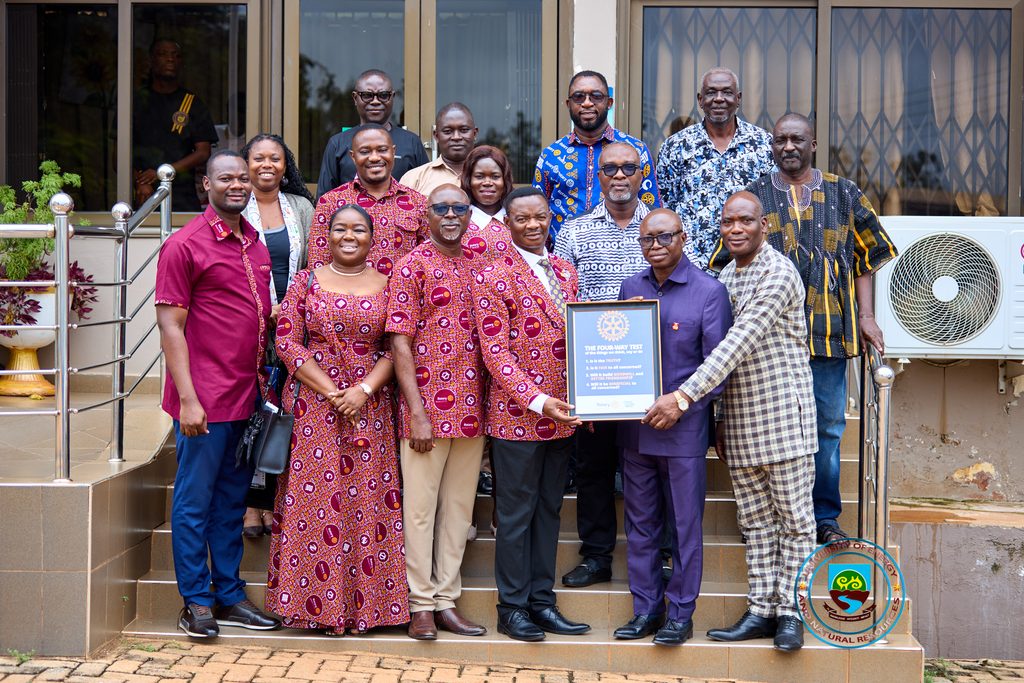
The leadership of Rotary District 9104, which oversees Rotary activities in Ghana, has expressed interest in forging a strategic partnership with the University of Energy and Natural Resources (UENR) to address pressing environmental challenges, particularly illegal mining and land degradation. The proposal was made when the District Governor of Rotary District 9104, Dr. Jack Andrews Dotsey, led a delegation to pay a courtesy call on the management of the university on Friday, August 28, 2026, at the University Council Chamber, Sunyani.
Receiving the delegation, the Vice-Chancellor of UENR, Prof. Elvis Asare-Bediako, welcomed the proposed partnership, noting that Rotary’s commitment to community service aligns closely with the university’s mandate of teaching, research and extension. He highlighted UENR’s expertise and infrastructure in environmental research, noting that the University has developed strong capacity in areas including climate change, environmental monitoring, land management and sustainable energy.
Prof. Asare-Bediako cited the Earth Observation Research and Innovation Centre (EORIC), which hosts a 24-hour satellite ground station for monitoring environmental hazards across West and Central Africa, as well as the University’s collaboration with international partners on climate, carbon monitoring, land degradation and renewable energy projects.
The Vice-Chancellor explained that the University’s research and expertise could be leveraged to support communities and institutions in addressing environmental challenges and promoting sustainable development. He noted that the Rotary philosophy of “Service Above Self” resonates strongly with UENR’s commitment to using knowledge and research to improve communities.
The District Governor of Rotary District 9104, Dr. Jack Andrews Dotsey, in outlining the purpose of the visit, said Rotary was particularly interested in collaborating with UENR because of the University’s expertise in environmental and natural resources management. He said the environment is one of Rotary International’s seven areas of focus and stressed the need for practical interventions to protect Ghana’s natural resources and restore degraded landscapes. He proposed that Rotary’s extensive community and professional network be combined with UENR’s technical expertise and research capacity to develop interventions aimed at addressing illegal mining, restoring degraded lands and promoting sustainable livelihoods.
Dr. Dotsey noted that environmental degradation poses a threat not only to Ghana’s natural resources but also to human security and the wellbeing of future generations. He therefore called on the University to support community-level initiatives with research, technical expertise and innovative solutions. He said the proposed collaboration would build on Rotary’s existing partnerships with organisations involved in community development and environmental initiatives, including Engineers Without Borders.
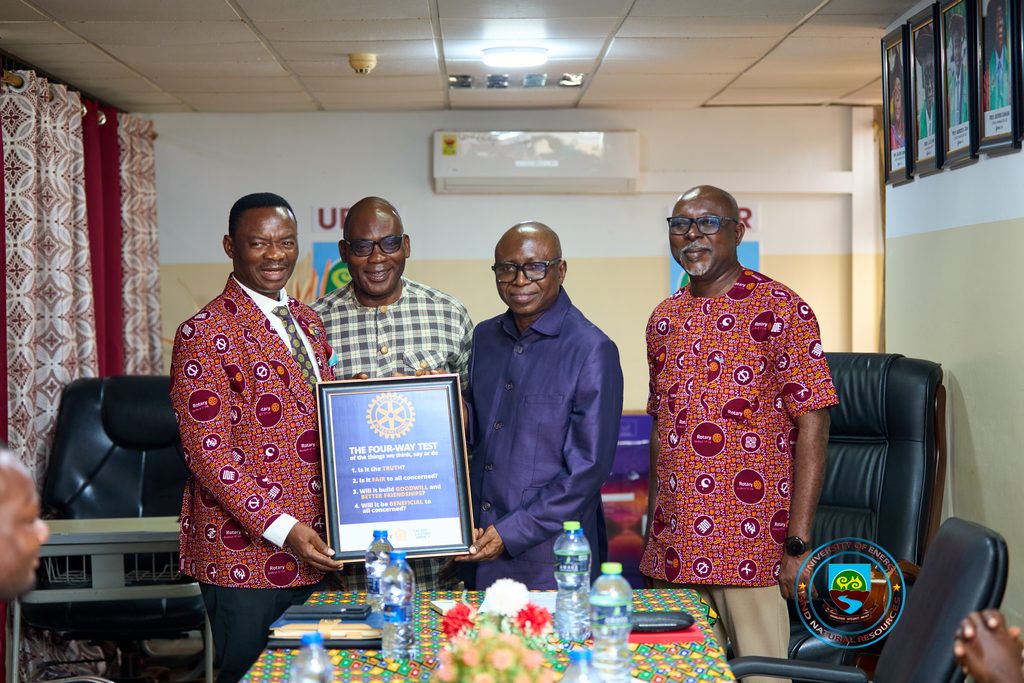
As part of the engagement, Dr. Dotsey presented the Rotary Four-Way Test plaque to the Vice-Chancellor as a framework for ethical leadership and decision-making. The Four-Way Test, which asks whether an action is truthful, fair to all concerned, builds goodwill and better friendships, and is beneficial to all concerned, was presented as a set of principles that could contribute to responsible leadership and sustainable national development.