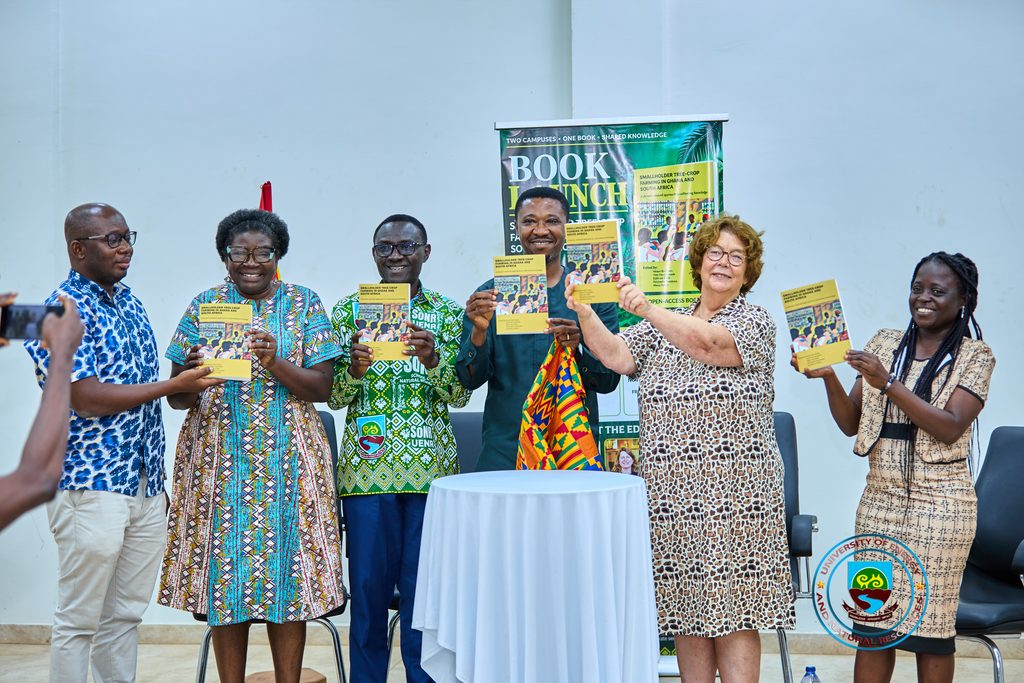
The University of Energy and Natural Resources (UENR) on Wednesday, November 4, 2026, launched a book documenting the experiences, knowledge, and innovations of smallholder farmers in Ghana and South Africa, highlighting the importance of incorporating farmers’ perspectives into agricultural research and development. The book, titled “Smallholder Tree Crop Farming in Ghana and South Africa: A Farmer-Centered Approach to Cultivating Knowledge”.
Representing the Vice-Chancellor, Rev. Fr. Prof. James Owusu-Kwarteng said the publication aligns with UENR’s mandate of promoting sustainable economic development while protecting natural resources. He commended the researchers for contributing knowledge that could support community livelihoods, food and nutrition security, and the sustainable management of natural resources. He also acknowledged the contributions of Prof. (Mrs.) Mercy A. A. Derkyi to the University, particularly in gender, administration, science, and student supervision.
Speaking at the launch, Prof. Derkyi, a co-author of the book, explained that the publication was available as an open-access resource, allowing students and researchers to access its digital version freely. She announced plans to reproduce hard copies locally in Ghana to improve access for academic libraries and other tertiary institutions.
She highlighted the collaborative effort behind the publication and acknowledged the support of the School of Natural Resources, the Department of Forest Science, and other institutional and individual contributors.
Providing an overview of the publication, the lead author, Prof. Mirjam Ros-Tonen, explained that the research emerged from an international collaboration initiated around 2013/14 to address food security challenges in Sub- Saharan Africa. She noted that conventional agricultural extension programmes had achieved limited results, partly because the recommendations offered did not adequately reflect the realities, needs, and circumstances of smallholder farmers.
The research, therefore, adopted a farmer-centred approach, creating district-level learning platforms where farmers could share their experiences, identify challenges, and exchange knowledge with researchers and other stakeholders. Discussions were conducted in local languages, with farmers forming the majority of participants to ensure that their perspectives remained central to the process.
Prof. Ros-Tonen cited examples of innovations documented during the research, including a female plantain farmer who developed directional planting techniques to protect her crops against strong winds and a local palm oil processor who developed specialised soap products to increase the value of her produce. These experiences, she noted, demonstrate that farmers are not merely beneficiaries of agricultural research but also active producers of knowledge whose innovations can inform more effective agricultural interventions.
The research further examined the diversity of smallholder farmers, identifying different farming arrangements and the varying challenges they face. It also explored how the expansion of commercial tree crops could affect land availability for food production and household food security.
Prof. Ros-Tonen emphasised the need for agricultural policies and extension programmes to recognise these differences and draw on the knowledge and experiences of farming communities.
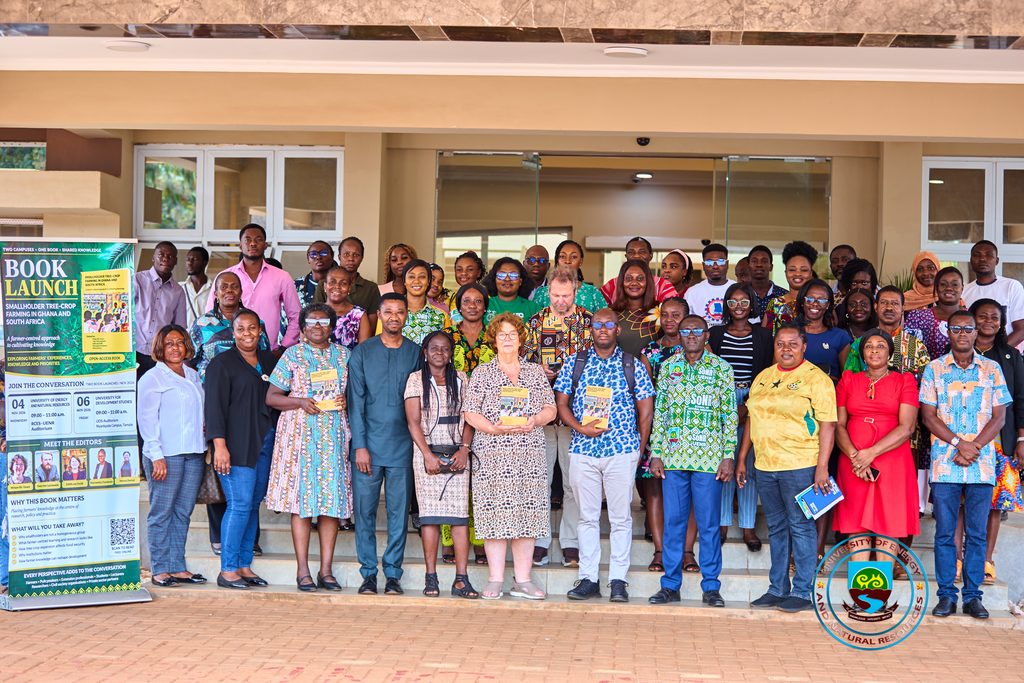
On behalf of the Dean of the School of Natural Resources, Ing. Prof. Emmanuel Amankwah underscored the importance of translating research findings into practical knowledge that could improve agricultural productivity, particularly in Ghana’s cocoa and cashew sectors. He observed that inadequate access to practical, evidence-based knowledge remained a critical challenge affecting crop yields and encouraged stakeholders to support the dissemination of the publication to farming communities.
Copies of the book were donated to the University Library on the Sunyani and Dormaa campuses to make the publication accessible to students and researchers.