
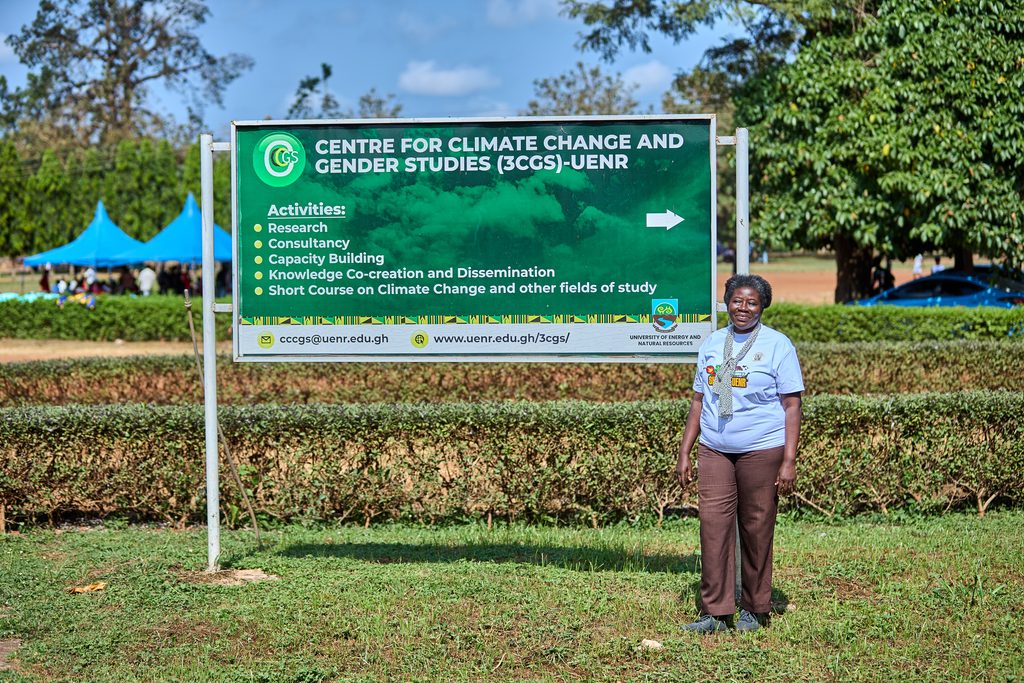
In recent decades, climate change has increasingly reshaped communities, ecosystems, water resources, and livelihoods worldwide. Its cascading effects contribute to deepening rural poverty and exacerbating the vulnerability of already marginalised populations. The Centre for Climate Change and Gender Studies (3CGS) at the University of Energy and Natural Resources (UENR) is strengthening efforts to translate climate change research into practical solutions that build community resilience to climate hazards.
As an evidence-based research and policy advocacy Centre within the School of Natural Resources, 3CGS focuses on the interconnections between climate change, gender, and natural resource management. The Centre seeks to bridge the gap between academic research and the practical challenges confronting communities affected by climate change. Its mandates include promoting, coordinating, and disseminating research and development initiatives on the climate change-gender nexus, while creating opportunities for capacity building in cutting-edge research and sustainable project implementation.
Prof. (Mrs.) Mercy Afua Adutwumwaa Derkyi, who was instrumental in the establishment of the Centre, currently serves as its Head. She brings extensive expertise in climate change, social research, governance, and conflict management within the agriculture and forestry sectors. The Centre’s multidisciplinary team draws on expertise from different fields to ensure that research findings inform policy, strengthen institutions, and support communities in responding to environmental challenges.
The Centre actively engages in community-based research to identify climate-related challenges, document indigenous knowledge and coping strategies, and assess local adaptation needs and priorities. By employing participatory rural appraisal (PRA) tools, community members are actively involved in the research process. Research findings are co-generated to reflect the experiences and priorities of the local people. This promotes community ownership and ensure that adaptation strategies are culturally appropriate, inclusive, and sustainable.
Currently the Centre is conducting comprehensive research across the Tano River Basin to investigate the cumulative impacts of the multiple drivers of environmental degradation of the basin, and how these changes are affecting local livelihoods of the surrounding communities. The research seeks to generate evidence that can inform sustainable river basin management, ecosystem conservation, and climate adaptation interventions. The Centre recognizes that community-based research is essential for bridging scientific knowledge and local experience, fostering locally driven climate action, and strengthening community resilience.
Beyond research, 3CGS places strong emphasis on capacity development. The Centre organises short courses, webinars and other learning opportunities as well as supporting the development of postgraduate programmes in sustainable resource management. It also seeks to strengthen research capacity among staff through activities such as grant-writing, support and knowledge exchange. Its strategic plan identifies research, innovation and capacity development as important mechanisms for contributing to UENR’s strategic objectives as well as Ghana’s climate, gender and natural resource priorities.
Community outreach and advocacy constitute another flagship area of the Centre’s work. Its capacity-building activities extend beyond the University to surrounding communities and educational institutions across the Bono and Ahafo Regions. Through its climate change education initiatives, the Centre engages young people in basic and second-cycle institutions using creative and interactive approaches, including drama, poetry, and PowerPoint presentations. As a yearly event, participating schools converge at UENR for inter-school quizzes and debates designed to assess students’ understanding of climate change and the impact of the educational interventions. The Centre has also established Climate-resilient Clubs in participating schools to nurture environmental stewardship, promote climate literacy, and inspire young people to become active advocates for climate action.
3CGS also works through partnerships with governmental and non-governmental organisations, researchers and other institutions within and outside the country. The Centre has been working in collaboration with Action Aid Ghana, Global Media Foundation (GLOMEF), Institute of Climate and Environmental Governance (ICEG), and others. The Centre identifies interdisciplinary and multinational collaborative research as critical in addressing complex challenges that have global patterns and promoting innovation and technology transfer. The Centre’s growing research capacity is reflected in the achievements of its researchers.
In October 2026, 3CGS Research Fellow Dr. Sylvia Adipah received the Excellent Youth Oral Presentation Award at the 6th International Forum on Big Data for Sustainable Development Goals in Beijing, China, for research on promoting land degradation neutrality through anaerobic digestion for resilient agriculture. The award adds to UENR’s growing research profile in climate resilience, environmental sustainability and sustainable development.
As climate change continues to pose significant challenges to communities and ecosystems, 3CGS remains committed to advancing research-driven, inclusive, and locally grounded solutions that translate scientific knowledge into meaningful action. Through its integrated research and advocacy model, the Centre continues to strengthen the link between knowledge generation and practical climate action. The Centre aspires to be a leading force in generating evidence, influencing policy, and driving transformative actions towards a climate-resilient and sustainable future for Ghana and beyond.