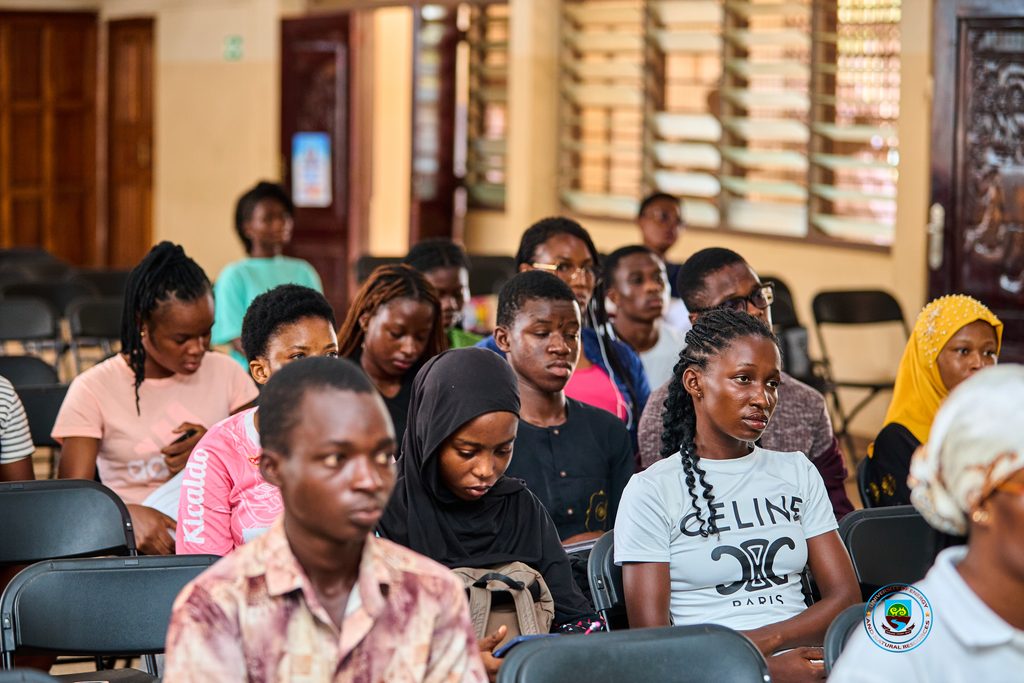
The Guidance and Counselling Centre of the University of Energy and Natural Resources (UENR) has urged newly admitted students to take greater responsibility for their academic development by adopting effective study habits, making strategic use of university resources and cultivating a positive mindset towards challenging courses. The call was made at a Study Skills Programme organised by the Guidance and Counselling Centre on Friday, 13 November 2026, at the University Old Auditorium.
Head of the Guidance and Counselling Centre, Mrs. Eva Atika Bakuri Dinye, cautioned students against assuming that spending long hours studying or having a high intelligence quotient automatically guarantees academic success. She explained that students differ in how they process, retain and retrieve information, making it important for each student to identify learning approaches that suit their individual cognitive profiles. She noted that the gap between the amount of time students invest in studying and their performance in examinations could sometimes result from the use of ineffective study methods rather than a lack of ability.

Mrs. Dinye therefore discouraged students from blindly copying the study routines of successful classmates or roommates, stressing that an approach that works for one student may not necessarily produce similar results for another.
To help students identify suitable learning approaches, she introduced a three-step process involving diagnostic assessment, individual feedback and the practical application of recommended techniques in students’ daily study routines. Students were encouraged to visit the Centre to undertake the assessment and receive personalised guidance.
The programme also introduced students to the academic support services available through the UENR Library. Senior Assistant Librarian, Ms. Harriet Fosua Attafuah, highlighted resources including print materials, past examination papers, the MyLOFT digital platform for remote access to electronic databases and e-books, Selective Dissemination of Information (SDI) services and the “Ask a Librarian” service.

Ms. Attafuah explained that university education requires students to move beyond the learning approaches commonly used at the secondary-school level. While secondary education often relies on prescribed textbooks, teacher-provided notes and structured study schedules, university learning requires students to take greater responsibility for finding, evaluating and synthesising information.
She encouraged students to develop their own summaries, focus on understanding concepts rather than memorising definitions and consult multiple academic sources to gain broader perspectives. She also cautioned them against relying exclusively on lecture slides or general internet searches, urging them instead to assess sources based on the qualifications of the author, the authority of the publisher, the currency of the information and its relevance to the research task.
Students were further reminded that librarians serve as professional research and information-literacy advisers who can support them in identifying credible sources, conducting literature searches and using academic information appropriately. Ms. Attafuah also stressed that using ideas from external sources without proper acknowledgement constitutes academic misconduct.
Addressing students on developing the right mindset towards difficult courses, Assistant Registrar, Mr. Benjamin Gyamera, referenced Aristotle’s observation that “the roots of education are bitter, but the fruit is sweet.” He noted that students often perceive courses such as mathematics, engineering mathematics, biostatistics and anatomy as particularly difficult. He explained that negative perceptions and self-limiting beliefs could become barriers to academic progress and encouraged students to replace negative self-talk with a mindset that views challenging subjects as manageable through consistent effort and appropriate support.

Mr. Gyamera outlined 10 practical strategies of overcoming a difficult subject or course; including mastering the basics, studying difficult subjects consistently, forming study groups, seeking assistance from lecturers and teaching assistants, and reviewing lecture notes regularly. He further encouraged students to attend lectures consistently, arrive on time, minimise distractions and remain actively engaged during lessons.
Students were also encouraged to use artificial intelligence tools responsibly as supplementary learning resources, particularly for generating practice questions and testing their understanding of difficult concepts.
Participants were taken through a learning-style assessment by the Guidance and Counselling Centre to help them understand their individual cognitive profiles and identify approaches that could support their academic development.