Ghana is sitting on a quiet paradox. With about 13.6 million hectares of arable land, the country has the natural resources to feed itself and more. Yet a significant portion of this land remains uncultivated, even as food insecurity, youth unemployment, and an ageing farming population threaten the future of the agriculture sub-sector.
Agriculture remains the backbone of the economy, contributing roughly 23 percent to Ghana’s GDP. Still, many young people see farming as a last resort rather than a viable, modern career path. Ing. Prof. Emmanuel Amankwah, a Senior Lecturer at the Department of Environmental Management, helps to explain why years of well-funded youth entrepreneurship programmes have delivered limited results.

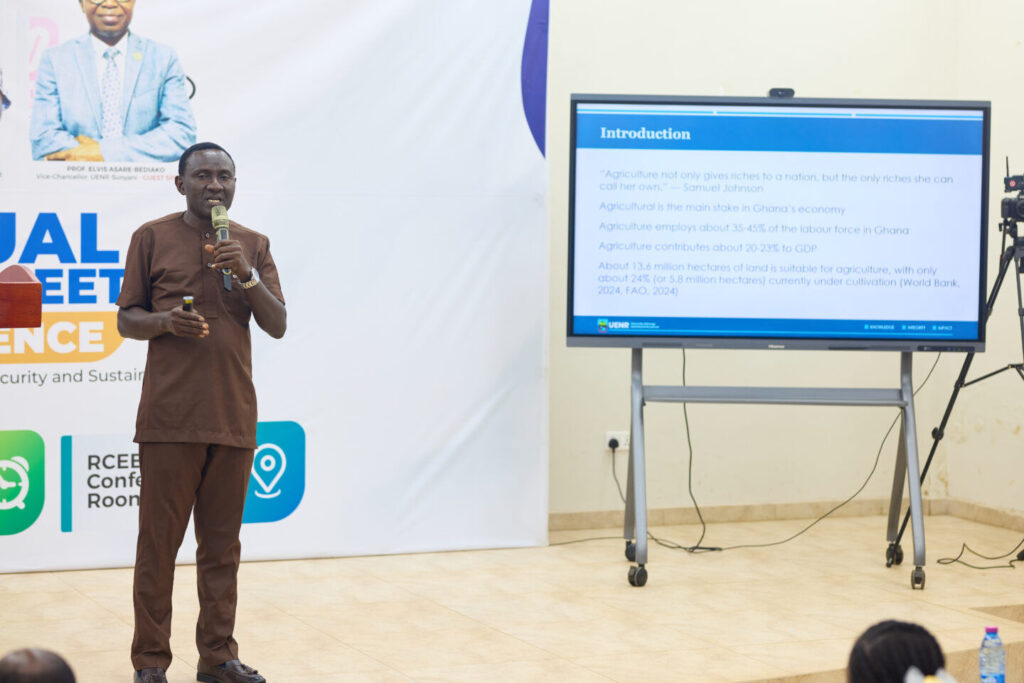
Speaking at the 4th Ghana Institution of Engineering (GhIE) Branch 2 Annual General Meeting and Conference, Ing. Prof. Amankwah argued that the problem is not simply a lack of funding or tertiary-level training. Rather, it is the assumption that entrepreneurship can be switched on in adulthood. Entrepreneurship is a mindset, he noted; one that must be cultivated early, long before young people arrive at university lecture halls or innovation hubs.
He stressed that the influence of the home is often underestimated. He revealed that research suggests that a large proportion of business owners trace their entrepreneurial journey to early exposure and parental guidance. Children, he explained, are like blank slates; when they grow up seeing farming not as drudgery but as enterprise, where technology, innovation, and value addition create opportunities, their attitudes towards agriculture shift naturally.
This, he noted, is where the school system becomes critical. Rather than treating agriculture as a marginal subject or an optional vocational track, Ing. Prof. Amankwah called for a rethinking of basic education. Introducing compulsory, practical agriculture at the basic school level could help normalise farming as a skill and a business. Beyond theory, school farms could become living classrooms, where pupils learn to grow vegetables, manage small plots, and understand food systems from seed to harvest. Such initiatives, he suggested, could even reduce feeding costs in schools while equipping learners with practical skills.
The broader goal of “agripreneurship,” according to Ing. Prof. Amankwah, goes beyond producing farmers. It is about raising a generation of problem-solvers, young people who are resilient, innovative, and environmentally conscious and who can build sustainable enterprises along the agricultural value chain. But these qualities cannot be hurriedly installed through short-term training programmes at the end of one’s education journey.
As Ghana looks to unlock its agricultural potential, the path forward may begin far from conference halls and policy documents. It may start in homes, classrooms, and school gardens, where curiosity is nurtured, hands learn to work the soil, and young minds begin to see agriculture not as a burden but as an opportunity. The future of Ghana’s food security, it seems, depends on planting the seed early.