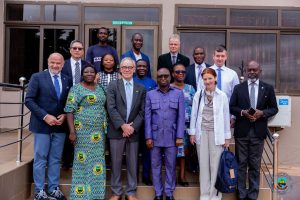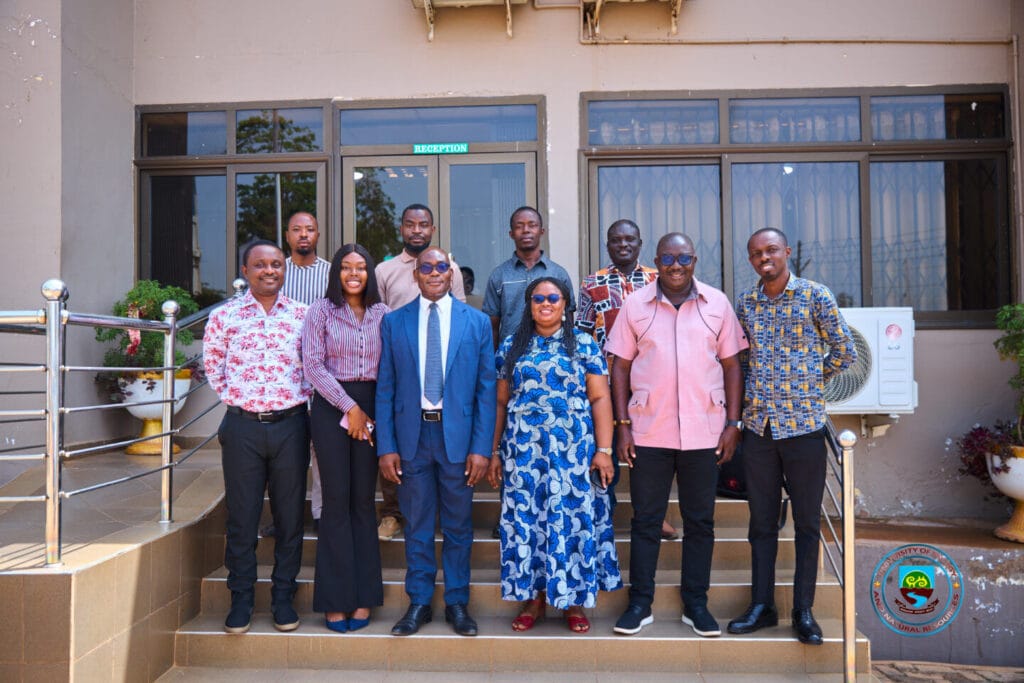
The Chief Executive Officer of Agri-Impact Group, Dr. Daniel Fahene Acquaye, has expressed interest in establishing a strategic partnership with the University of Energy and Natural Resources (UENR) to expand agribusiness innovation, digital transformation, and youth employment opportunities.
During a courtesy visit to the University on 23rd February 2026, Dr. Acquaye described Agri-Impact Group as one of Africa’s leading agribusiness management firms, with consultancy and operational experience spanning over 30 countries across Africa and the Caribbean. The Group works closely with major development partners, including the World Bank, the African Development Bank, and the Mastercard Foundation.
He noted that the Group is particularly strong in greenhouse agriculture and currently manages the largest greenhouse project in Ghana. Dr. Acquaye further highlighted the Harnessing Agricultural Productivity and Prosperity for Youth (HAPPY) initiative, implemented in partnership with the Mastercard Foundation, which aims to create employment opportunities for 326,000 young people in the agricultural sector.
Under HAPPY, several engagement pathways are available to youth, including internships (pre- and post-National Service), National Service placements, and the Young Agribusiness Professionals Programme.
Providing further insight into the technological dimension of the initiative, the Project Lead of the HAPPY Programme, Professor Nana Ewusi-Mensah, explained that e-HAPPY serves as the digital and innovation-driven wing of the broader programme.
According to Professor Ewusi-Mensah, since its inception two years ago, e-HAPPY has trained nearly 1,000 young people across various sectors. The programme currently operates under four key pillars, with plans to expand to seven.
The Dronepreneur Pillar trains youth in drone operations and precision agriculture services. Through this initiative, the Dan F. Acquaye Drone Innovation Unit was established and is regarded as one of the largest drone facilities in Africa, equipped with 11 multispectral drones and a high-capacity precision agriculture drone.
The programme also includes the COFED Pillar, which trains youth under 35 in coding and digital skills; the e-AgriPreneur Pillar, which develops technology-driven agribusiness entrepreneurs; and the HAPPY Tech and Mentorship Pillar, which strengthens peer-led innovation and knowledge transfer within the HAPPY ecosystem.
Responding to the proposed collaboration, the Acting Pro Vice-Chancellor of UENR, Professor John K.M. Kuwurno, reaffirmed the University’s readiness to formalise a structured partnership.
He emphasised that entrepreneurship is embedded as a core component in most UENR academic programmes, with students undertaking structured entrepreneurship training over two years. He also highlighted the University’s strong performance in the Kosmos Innovation Centre (KIC) initiative, where several student groups have emerged as winners in recent years and are nurturing viable enterprises.
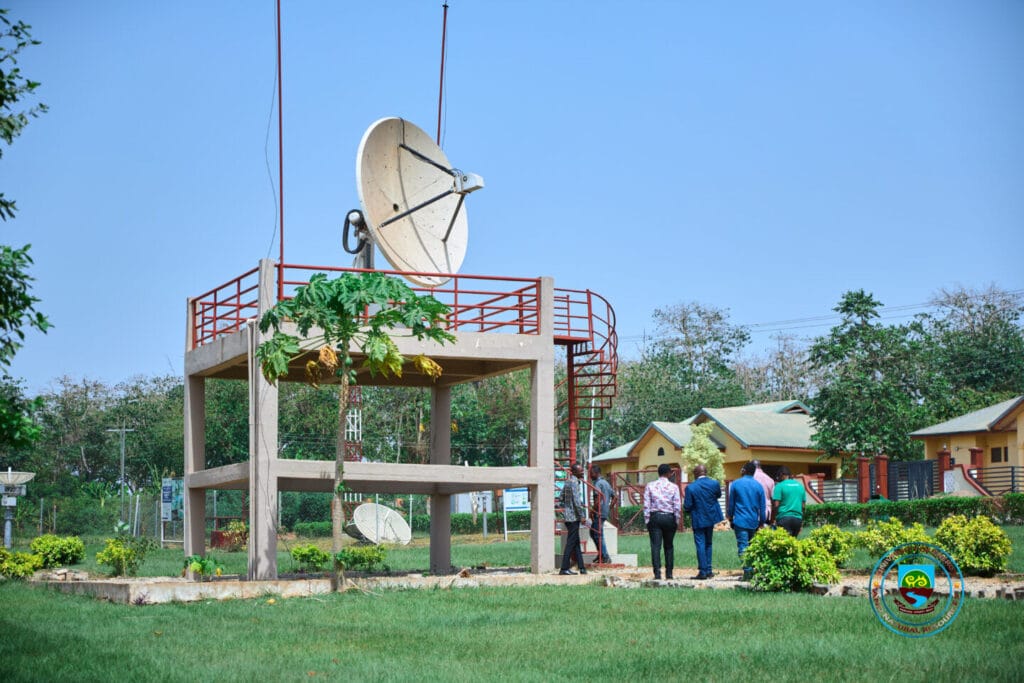
Professor Kuwurno further outlined UENR’s extensive research and agribusiness infrastructure, including greenhouse production units, aquaculture facilities, solar-powered irrigation systems, poultry farms, operational weather stations, and over 2,000 acres of arable land across its campuses. He also referenced the Earth Observation Research and Innovation Centre and the University’s carbon monitoring facility in the Tano Bia Forest, which supports data-driven agricultural and environmental research.
Ahead of the signing of a formal Memorandum of Understanding (MoU), Agri-Impact Group announced an initial commitment to donate two multispectral drones to UENR and provide specialised training for four UENR students under its upcoming Dronepreneur Programme. The gesture is expected to strengthen the University’s capacity in precision agriculture and digital innovation.
The visit was climaxed with a tour of the satellite farm at the Earth Observation Research and Innovation Centre (EORIC) and the Aquaculture facility.