By the middle of this century, the world’s population is expected to reach 9.7 billion. For Ghana, that figure is more than a distant projection; it is a quiet alarm bell. Across farming communities, the signs are already visible: unpredictable rains, declining soil fertility, and post-harvest losses that leave farmers with less to sell and families with less to eat.
At the heart of this challenge, engineers are stepping into a role few once imagined for them; reimagining how food is grown, stored, and delivered.
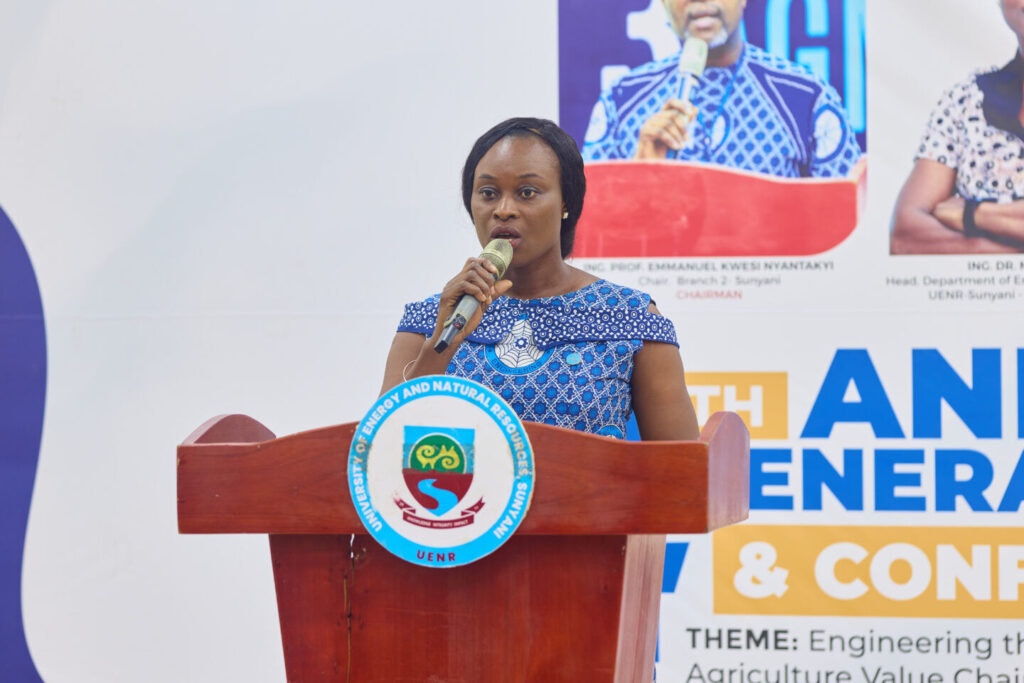
Speaking at the 4th Ghana Institution of Engineering (GhIE) Branch 2 Annual General Meeting and Conference, the Head, Department of Environmental Management, Ing. Dr. Mary Antwi, challenged engineers to look beyond bridges and buildings and see agriculture as a critical frontier for innovation. She warned that traditional farming methods can no longer keep pace with the pressures of climate change, population growth, and environmental degradation.
She stressed that Ghana is at a point where innovation is no longer optional; it is a necessity.
Across parts of Ghana, that innovation is already taking shape. Drones equipped with multispectral cameras now sweep over farmlands, detecting moisture levels, nutrient deficiencies, and early signs of pest infestation. What once relied on intuition and experience is increasingly guided by data, enabling farmers to intervene earlier and reduce waste. Smart irrigation systems are also making a difference, cutting water use significantly while improving yields, an important gain as water scarcity becomes a growing concern.
Yet engineering solutions are not only transforming fields; they are reshaping where food can be grown. With urbanization steadily reducing available farmland, controlled environment agriculture such as hydroponics, aeroponics, and greenhouse farming is opening new possibilities. Facilities like the Dawhenya Greenhouse Village demonstrate how vegetables can be produced closer to urban markets, using less land and water while delivering higher yields.
The journey from farm to market, however, remains one of Ghana’s weakest links. Large quantities of food are lost after harvest due to poor storage and limited processing facilities. Here too, innovation is quietly changing outcomes. Hermetic storage systems help preserve grains, while solar-powered cooling technologies extend the shelf life of fruits and vegetables in off-grid communities. Simple but effective tools like moisture meters, improved cassava-processing machines, and locally developed equipment such as the Choco Smoker are reducing spoilage and adding value to farm produce.
Despite these advances, access remains uneven. High costs, limited technical skills, and weak rural infrastructure continue to slow adoption, particularly among smallholder farmers who produce much of Ghana’s food. Ing. Dr. Antwi called for stronger partnerships between government, industry, and academia, alongside targeted training, to ensure that innovation reaches the communities that need it most.
As Ghana confronts the twin pressures of climate change and population growth, one truth is becoming clearer; the future of food security will not be shaped by farmers alone. Engineers, working alongside communities, may well hold the tools to feed the nation.